Showing posts with label visual complexity: mapping patterns of information. Show all posts

how to read comics,
part zero point three repeating:
on imparting the delicate art of sight


pollock left; simulated nerve structure right

Comics are dying. They've been dying since the form was born, of course. An endless la petite mort of ego death, comics, the art form of the gutter and of the poor and of the unwashed, was and is as the phoenix: forever dying simply in order to survive. Today the direct market and the superhero have cannibalized themselves down to nearly nothing, vampiricly sucking away at the readership and the artistic potential in order to grub more money from the addicted geeks and the movie-going mainstream (oh capitalism, you scamp you!). And while people have been predicting the death of comics for as long as they've been around, and will continue to be quite wrong in such predictions, the times, as ever, are a changin'.

I wrote in an earlier iteration of this column about the so-called "dominant mode" of comics reading and compared it to something like homogenization or gene-pool thinning. And I do still stand by those metaphors. But I do not fear for the medium because of them. I fear for the market, certainly, but not for the medium. 


The dominant mode will live on and most everyone will participate in continuing to maintain and enforce its dominance.


And that's fine.


It will endure. Like tract housing, the dominant mode will endure. And similarly, it will all be built the same. Each different enough to fool everyone just a little, but if you squint hard enough or look with just the right kind of eyes: all built the same. Worth to found there in the suburban tract, to be sure; inventive, interesting innovation and design. Clever problem solving. But art... hard to defend the tract as art. Especially if you were raised in Northern California in the architectural experiments of old, retired bourgeois-bohemians.


The form will still flower on in its unique idiosyncratic way, as always, but the dominant mode, the tract, can never be killed now. The dominant mode is comics for 99% of the people who will ever interact with the medium. Built, operated and thought-of all with little depth. Just a thing to be moved through. Contemplate not, oh reader!


Now, this is where I have to take a step back through all the affectation and hyperbole and say again that that's all fine. Comics don't exist in a radio-and newspaper dominated mass-media landscape anymore and haven't been king of that particular hill for lifetimes now. If you want people to care about and read comics in the year 2013 you have to realize that those same people, in all likelihood, get more than enough entertainment and escapism and cultural involvement from movies video games television shows and social media.

Comics generally do not compare. They're too much work! And not just for the folks who make them! But for the audience! Comics (and static visual art more generally) just require too much active (and rather ethereal, abstract) engagement.

This is where the dominant mode comes in, of course, to engage for you.


Hours upon hours of screen-training overlapping with basic reading ability and lack of artistic appreciation, emerging as a moire pattern of graphic mediocrity. Instead of resetting the eye every time and softening the focus and running the visual networks in practiced auto-pilot, the brain instead falls into the same old well-worn rut of the prose-colored, tv-tinged, oh-so-casual dominant mode. This is why there is a lopsided over-concern with story and narrative in comics criticism: the reader often sees only actors and scenes, not also icons and relationships and ratios and lines and shapes and structures, all of which can have a wide range of emotional and intellectual meaning coded into them.

As I said in the first iteration of this column: the dominant mode stripped out the inherent graphic nature of the medium to communicate using the grammar of the camera and to so grab the audience used to the same.

And that's fine.

Business as usual. The regular dynamic; the simple jams.

That's not all that we want though, is it? We want more, surely?

We also want to see with new eyes. We want to rebuild the dynamic. Destroy it to save it. Remodel the house, to recall the original metaphor. Let's get back to those load-bearing walls now, my apologies about the meandering. So, the word balloon and the panel. The load bearing walls of the medium. Some of the basic units. But those two things, as with the framing of a house, are in fact built on something stronger and deeper: the foundation. The foundation of the comics medium is the page. Actually, that's not right.

Because there's a foundation to the page too: the ratio. 

The ratio is king.


Whether landscape or portrait, infinite scroll or finite single-panel gag, the ratio rules over the medium with an iron fist, inescapable  The page and the screen are derivations, transformations, of the ratio. Proportions and their inherent geometries are what power all visual art, and comics are not exceptions to this universal law. Whether tall 1.5 ratio american action comics or 1.3 ratio comics of manga and magazine proportions or long newspaper strip collections and more, the page and its rules are built on the ratios of inherent spatial relationships.

In understanding the blueprint of the dominant mode we start with the foundation of the ratio. On top of the foundation of the ratio comes the floorplan of the page, with its inherent geometries, on top the page, the load bearing walls of the panels and the balloons, then the basic framing out of the placement of figures and background and the other coded icons, then the utilities are installed with the finished pencils and inks then the finish work of the the colors and then I'm really stretching this metaphor far beyond where I should've. Ugh. Hope you got the point though.

Anyway, most folks concern themselves with the actors and the scenes: the words, the visceral emotional reaction to the art, and the transition between iterations of those two things. Read, glance, read, glance. Prose, emotional tinge of image, prose, emotional tinge of image.

Comics more as illustrated prose experience than as symphony of image interrelation.

And like I've been saying, there's really nothing wrong with that.


But it's not the be-all end-all; it's only one mode.

We can can attach our spectrum of emotional response to things beyond just our instinctual recognition of faces and body language. This is what I was talking about in the first iteration of the column about how all this art shit is all a highly trained impulse and not as natural as some like to wax lyrical about. Emoting in response to things that do not touch us in an instinctual way is such a trained impulse.

Faces we're built to emote in response to. And words and language are where our sense of higher self is largely rooted. Emoting in response to those things is easy; natural. It's not quite so natural to do so in response more abstract stuff; to a Jackson Pollock or a Picasso or what have you. "How the fuck am I supposed to react to these splashes of color! Give me something I recognize, goddammit!" This is the dominant mode: Everything you recognize. The usual dynamics. The too life-like, too cold, evocations.

None for me thanks, I'm good. Give me Color Engineering. Give me Lose. Give me Zegas. Give me a dynamic to learn, a unique ratio-rule-set I do not recognize!

Give me a unique home to explore.


And so after awhile of only responding to the surface level, easily-decoded-by-anyone-who-can-read comics experience, the reader builds up a perception of story as wholly separate from the story-telling, when these things are actually so close as to be inseparable.  The medium is supposed to be part of the message, you know? The art is the story. Or at least, it's supposed to be. But the quality of visual storytelling isn't what most comics readers come to the medium for. They come to see what happens in the plot and to the characters. The what becoming more important than the how. The end justifying the means. The experience becoming more about channeling characters and voices than about complete visual sublimation into the space of the page.

This is the goal: process the page in every way possible. Complete submersion in the image.

Now, this is where I have to get a little personal again, because all I can speak to is my experience in this little particular. Like I said in the earlier column, my father was a general contractor and I've been on construction sites more or less my whole life. I was running cuts when most kids were just running around. I used to watch houses grow up around me as I did, each beating me every time, skeleton to skin. Growing up in a continuous assemblage of the technological accretion that is the modern american house you learn that ratios, proportions and relationships are incredibly important in construction and architecture. 

Hell, they're important everywhere, really, but even the layman should be able to understand the paramount importance of ratios, proportions and measurements in architecture. Whether you're working on the small scale to develop a custom finish trim pattern for a room or rooms, or whether you're working out the spacing of beams on a trellis or designing the basic footprint of a foundation any or a million other things, the aesthetics and interrelationships of the patterns are paramount.

It's difficult for me to put this sort of thing into language, but over time you just develop an eye for proportion and distance and relationship. A practiced accentuation of the brain's inherent pattern recognition capabilities: "That doesn't look quite right, move it like 3/16ths to the left... yeah, yeah, right there, that looks good. The lines match now, see?"


Everyone who's any good at their job develops this sense of harmony with the things they're in charge of, whether those things rely on visual processing or otherwise. And most comics artists worth their salt manage to develop unique rule-sets beyond the dominant mode, creating their own unique visual language. Many do not though. Many create only a surface sheen, speaking the same old action-comics dominant-mode language as ever, only with a very slight filter over the camera. They have not the energy or ability to self-generate a unique visual language. They just play the old tunes in new ways; a tradition as long and storied as it is boring. None for me thanks, I'm good.

So I suppose what I'm saying is that an upbringing in construction and its visual focus and structural rules, has, in a strange and unexpected way, greatly affected how I read comics and interface with art.

I'm not sure if that's an accurate judgement or not, though. It smacks of narcissistic self-aggrandizement to me, and I need to explore it a little more to see if there really is gold in them thar hills, or it's only just the pyrite of ego. Hopefully a little of both.

Alright, let's pull together here: Visual art, and architecture and building in general, are built on aesthetically pleasing ratios and relationships which have absorbed so fully into everyday life they have become invisible to us. In comics these have melted into the texture so completely that we rarely address or work with them, despite the fact that everything is built on the foundations of them. The page is the expression of the ratio; the floorplan to the foundation. The load-bearing walls of the panels and the balloons are built atop the foundation according to the floorplan, etc, etc. I'd stretch the metaphor out to breaking point here, but I kinda already snapped and broke it about a thousand words ago, so yeah.

I dunno if I'm making any sense with any of this, but it's about seeing all the perspectives on the process and understanding the through-lines that govern the systems. Whether those are architectural design languages or visual compositions of pages, posters or anything else. It's about making the patterned connections and aligning elements with the pattern or setting them in opposition to it.

Alright, so, two thousand words into this damn post I'm finally going to get to the point, here: How to Read Comics. You read comics (and static visual art at large, really) by visual networking. I just made that term up, but let's run with it. 
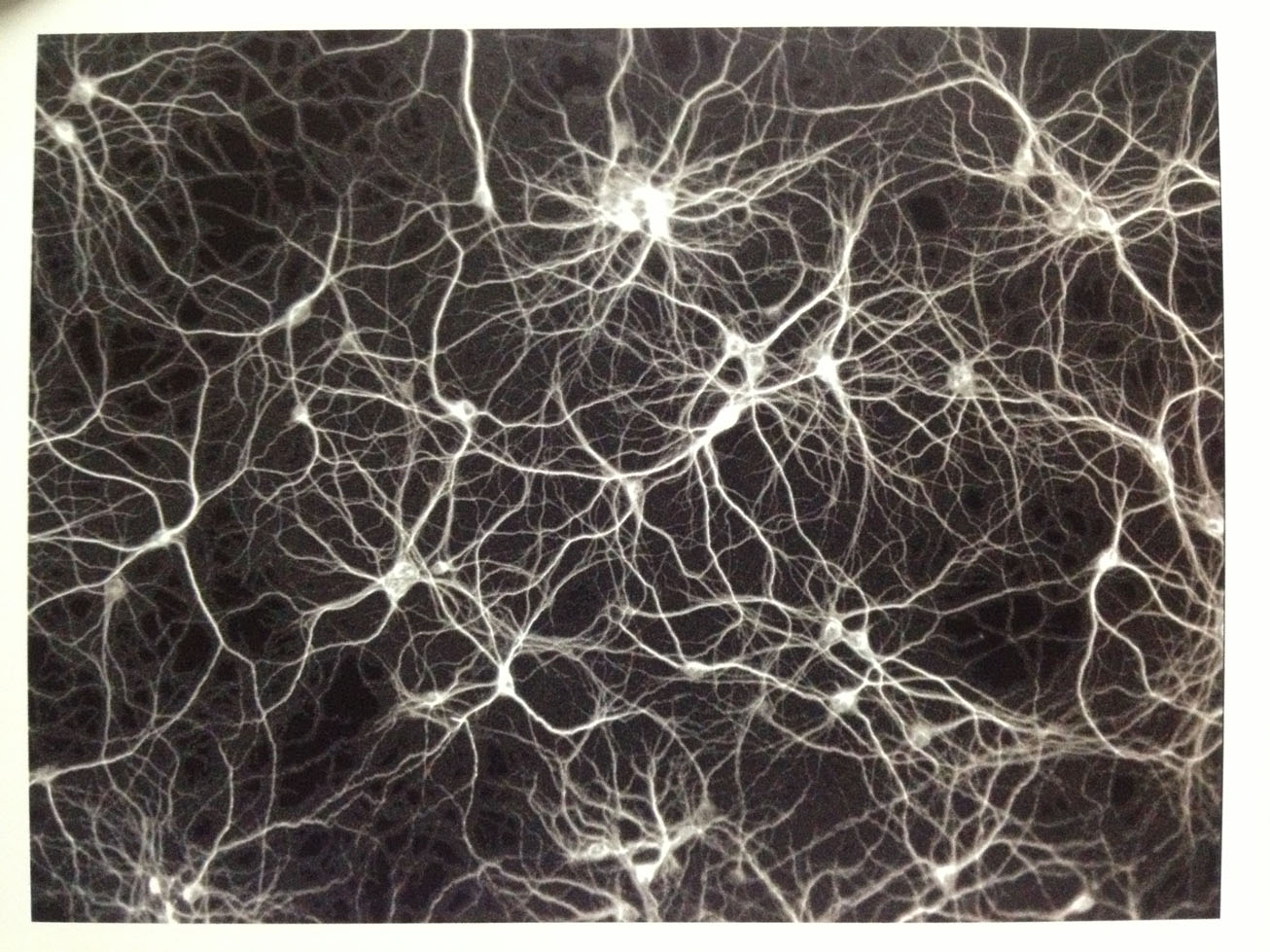

rat neurons


We're going to do a little thought exercise together, here.

Look around at the room you're in. Take it in. You're probably already familiar with it, but go ahead anyway. Then close your eyes and try to remember the space. Not the colors or the objects or the light sources, but the spatial relationships. Think almost in wireframes. Now zoom out a little. Imagine the next room or the hallway. Zoom back in on the room you're in. Zoom out to how much of the whole building you're in that you can manage to spatially recall.

Can you do the whole internal fractal-zoom-out, soup-to-nuts, from the room you're sitting in, out to the larger rooms and the layout of the building, out to the layout and shape of the surrounding buildings out to the layout and shape and directional orientation of the streets and the larger suburb or neighborhood and out from there onto the larger shape and orientation of your town or city and then onto the county and state or province or country out to the shapes of the continents and the oceans?

And can you do the opposite? How well do you know the shapes and relationships of you own body? The organs and the systems?

Try to recall all the interlocking shape-structures in your head. Do your best. This is practice. You are exercising your spatial processing abilities. And lest you think I'm being unfair: I am. You need considerable practice to be able to do something like that, but make no mistake: any artist worth his or her salt should be able to do such a thing just by closing their eyes and thinking about it. They take in the structural rule-sets as just another language to be spoken. And hell, you could do that planet-level zoom-out in eight panels of comics if you just laid out your beats right.

The point is to learn to see all the perspectives from within your own. To integrate all of the viewpoints available to you within the system. If you're a comics reader the idea is to filter that image in every way possible. Those image rollovers I do here? All that stuff and more should be happening upstairs in the heads of every comics reader just as a matter of course in the reading experience. The reader should be visually networking the icons simply as a part of the interaction. In fact, I would be such an aesthetic Nazi as to say that the visual networking of the icons is actually the real and true comics-reading experience. 

So, what do I mean by that made-up term? Well, nothing too concrete unfortunately. Yes, I can say to do all the image-rollover-bullshit in your head or whatever, but that's not particularly useful advice. We're in very hazy territory here, walking across linguistically thin ice. Dancing about architecture; trying to describe in language the mechanics of wholly non-linguistic processes. The better thing to do here would be to record a video or something, where I can point at a comic with a stylus or just my finger and create very clear visual references without the mess of thousands of words of prose just to sum up single images. Just use the compressed time and space of YouTube to give a rambly lecture, complete with visual reference.

Denser information transference, you know?


simulation of galaxies and quasars forming


Anyway, I may try to do that at some point, we'll see. Maybe when something notable releases and I can get in on some of its early zietgiest. Maybe I'll do video annotations of Copra#3 or something.

For now I'll end the column with a few made up terms to ponder and their working definitions (it must be said that there's a whole science of image analysis whose methods and terminology I'm largely ignorant of here):

Trackable Floating Point Icons - In comics: the marks on the page and the inverse negative spaces implied by the marks. Often constructed with respect to recollections of real-world experiences. In art at large: the shapes within the ratio of the canvas or poster or what have you.

Fluid Visual Network Analysis - The internal process of connecting and aligning singular or multiple floating points within an image based on similarity of shape, color, alignment, scale or just about any other criteria. The continuous comparison of ratios; the reading of images.


Alright, that's more than enough rambly bullshit to be getting on with. If you
made it this far, you've my endless thanks and my sincerest apologies.
I'm pretty much feeling around in the dark here, so thank you so,
SO much for sticking with me!

Most images from Manuel Lima's ever-amazing Visual Complexity: Mapping Patterns of Information,
with a single image from Jim Krause's Design Basics Index I trust you can figure out which image that was

how to read comics,
part zero point none:
insults & incoherent ramblings


this post a combination of linguistic affectation and automatic writing. go go go!!

Word balloons, color use, facial expressions, body language, page design, you know your shit don’t you? Yeah, yeah, you think you know all the fancy-pants rules to read comics, unlike those damn plebeians, always reading those books that look the same on every page, and most of whom couldn’t manage to fathom the reading of images even if you actually handed them a map (ba dum pssh). Yeah, you’re graphically literate, aren’t you? Pictorially intelligent? Sure! Artistically aware? But of course, right?

Yeah, no. You know nothing.

Actually, no, that’s just idiot hyperbole. You have to know quite a bit to even be a casual reader of comics. But well, sorry, you’re probably still a relative lightweight when it comes to image analysis if your knowledge of reading pictures originated with comics. Which, for many comics readers, it of course did. The problem with that is that comics uses a massive number of crutches just to visually get by. Chief among these crutches are the word balloon and the panel. Actually, maybe crutches isn't the right word. Wrong connotations. But the word balloon and the panel are the parts of the structure that everyone actually leans on. They’re the load-bearing walls of the medium, if you will.


Perhaps it’s because I’m a tradesman and grew up in a construction family, but the image of a strangely-built house comes to mind...

I grew up in Sonoma and Marin counties in northern California and my father was a general contractor. Since long before I can properly recall I’ve been visiting houses and learning of their essential structures and bodily make-ups. The comics medium occasionally reminds me of some of those houses I’ve worked on out in Marin: idiosyncratic and unique in so many ways, but highly, highly specific and very difficult to fathom from the outside. Coming in to do work on or in a house like that is always a strange experience; attempting to understand the mechanics that brought this fascinating monstrosity into existence, and what the (sometimes) absolutely insane rules holding it up actually are.

There’s a continuous feeling, exploring those jobs during the initial exploratory and demo stages, of: “What the hell happened here, and how are we going to figure it out and work around and fix things?!” Think like the Winchester Mystery House, but slightly more practical.

Really quite an apt metaphor for our strange and terrible little art form.

But the parsing of it, the throwing off of the crutches, the remodeling of the house, the building of a more rewarding reading experience. Just how do we go about this?

I’ve little idea as to the specifics of the evolution of the word balloon and the basic panel, but I’m sure the work has been done, and while I would quite love to know, we don’t really need to go all the way back down the genetic line just in order to learn how to our observe our creature’s behavior today (but if such scholarly work is easily linkable or searchable, please don’t hesitate to comment with the info!).

Most folks (probably not any of the seven or so people who read this blog) who read comics do so in a very casual way. Very quickly, pausing usually only to resolve a moment of confusion or to briefly appreciate an image, then hurrying on. This is how we’re taught to read prose. Move along, move along, sound out, clarify, double check, repeat if you like a turn of phrase, move along, move along. Very casual. Very linear. And not a thing wrong with it. A great many of the comics form’s subspecies and idiomatic approaches are designed mostly to be read this way. Gag strips, 1-4 panelers, a good deal of manga, most mainstream western-direct-market stuff, etc. This is not, however, the only way. You cannot read comics by Brecht Evens or Jim Woodring the way you can those. The lack of words has a lot to do with that, and we’ll return to words and language at large in the reading of comics soon enough, but it’s really more than just that. 


It’s more than just the lack of words, it’s the composition and the coding of the images. As quoted in the Fiffe & the Rule-Set of the City post from Clarke's Fractals - The Colors of Infinity, it’s the visual dictionary, the pictorial grammar, the depth and coherence of the complex fractal-self-similarity.

People compare comics to music and go on and on about the importance of composition and arrangement. Guys like Marcos Martin draw zoom-ins on ears, Matthew Southworth tilts a page 90 degrees, people go crazy for that shit. They need the pop songs, the simple jams. The same old tunes. 
Business as usual. The real music, the real compositional tricks and visual bridges and mood evocations are being done elsewhere, if only you’re willing to bend your brain to perceive them.

There is no right answer in the singular sense, though.


No one correct perspective.


You have to cycle through the permutations. Every perspective is the right perspective if you can only manage to stare through them all at once. Why do you think Morrison and Moore and others are fascinated by the simultaneity of time and by super-position and phase-space and by temporal-lobe warping experiences? That's where the truest sight supposedly resides. And it’s very difficult not to have yourself be dissolved by that endless abyss of perspectives. That’s why forging through it is the final task for the mature magician.

We’ve no need for the ancient out-of-date maps, though.


Come, take my hand, there’s an easier crossing through the acid...


It’s the rare person who feels confident in their relationship to art and to the perception of it. Such a subjective thing, you know? So wide-ranging, it’s difficult to speak to with any real sense of authority. Can there be said to be a universal user interface for the canvas? Just how do we learn to emote in response to imagery? Oh, it’s simple enough with representational imagery, like in most comics and in most art at large. In a comic if it’s a guy throwing a punch or shooting a gun: action, energy, power. If it’s a light-blue-violet-lavender-reddish-yellowish-orange sunset over a slowly darkening valley: nostalgia, warmth, wonder.


But we need to be trained to do this. I know guys to whom I could hand The Love Bunglers and who would feel nothing from the experience. Or I could hand them whatever painting you want, instead. They’ve less-than-zero experience with artistic emotional exploration or personal processing of art at all. The closest these sorts of guys get is … god, video games, I guess? Seriously, these are not art people at all, and folks with any sort of relationship to art at all (myself included; myself especially) often tend to forget just how trained an impulse the whole thing really is.

As with most things in life, it’s all about the practice and the training.


I know all this doesn’t sound very romantic, and that everyone experiences everything differently and everything’s subjective and all that bullshite. But I tend to think a good deal of that has to do with depth of perception and ability to explain personal emotional reactions. Zegas 2 for example can be read at a very surface level, with most of its informational content passing right through the perceptual bowels of the reader, little absorbed at all. Or it can be read deeply, all the informational content it possesses digested. All the nutrients absorbed in every way possible. Eaten with every emotion, perceived in every spatial way possible, seen ontologically, seen hauntologically, approached from every possible method of perception you comfortably possess. All the permutations cycled through.


Every view cataloged and contained, one at a time, faster and faster, until the comic echoes on in your head, a multi-faceted, super-positioned, little living memory.

There are the dominant modes of perception, of course. Those reading systems that have harmonically accreted. Evolved, essentially.


The simplest mode is the one most everyone uses, the one that everyone relies on and that most readers never lean off of. To be fair, most creators don’t really challenge them to do so. But we’re talking about the reading of images here, and the inverse, the creation of images, is a whole other ballgame. Related, sure, but related is the way American Football and Rugby are related: similar, but really completely different things. Besides, there’s nothing inherently wrong with creating a comic with a relatively low amount of very-traditional information per page. Or even a comic with a high amount of very-traditional information per page. It’s not just about the density to me, really, but about the quality and the novelty.

As in the case of reducing color images to value-structures, the reducing of all page-content to simple information changes our whole perspective on the issue by altering the terms by which we perceive it. We need to remove our preconceptions and biases to cross into new knowledge. Removing our attachment to style and to color and to all other attractions and bloodlessly examining everything from the perspective of patterns and information. Then, having boiled everything away, we move slowly back down, recondensing and reconsolidating and remodeling and rebuliding our understandings of things.

We’ll start with the load-bearing walls. With the panel and 
the balloon.

Most folks just jump from one to the next. Reading the balloons, glancing at the the icon system they’re pointing at, then moving on. Very casual, mostly dialogue driven. Is it any wonder Bendis is as popular as he is? Dialogue and language and words drive the dominant comics reading experience. That and the most basic and trite of panel progressions. Visual storytelling and form/content interaction largely take a backseat. Photo-reffed or shadow-shape-based illustrative "quality" moves to the forefront to dominate... 
In this way, the stacked-coffins, storyboard-based, tv pitch-comic comes about.

The dominant mode boiled out all the fun tricks and the inherent graphic (as in pictorial) nature, as creators powered by pan-media bullshit sought to make all their media move and feel the same. The dominant mode is now just like watching a shit tv show. Which of course many direct-market comics-readers do a great deal of, and which is the larger dominant mode of entertainment culture in general.

(Note: This is one of those moments when I want to go back to the bridging concept and Fiffe & the Rule-Set of the City and try to compare it something like horizontal gene transfer or something. Things shift sideways, associations bridging laterally and introducing new things or transforming old ones. It's just that in the case of the dominant mode of the direct market, the gene transfer from the larger media world has been detrimental to our genetic variety, thinning the gene pool. We have been largely homogenized by the bigger entertainment industries and are now being farmed for our variety-within-tight-bounds, super-market-safe (get it? get it?), product. The vast explosion of work in the last decade or so doing nothing so much as proving Sturgeon's Law to be absolutely correct.)

This is why any basic artistic or narrative tricks pulled in the direct market seem like goddamn magic to most readers therein: any deviation from the dominant mode will of course seem like boundless innovation if the dominant mode is all you know.

The dominant mode also fetishizes the surface quality of the art, as well.


Having no critical language or greater artistic experience to hang perceptions on and to there build a unique sense of taste from, the basic emotional reaction and language surrounding that builds up instead. Like a toenail ingrown or a plant shut in the dark, the focus grows toxic and turns inward, with the emotional reactions never incorporating other perspectives than the first, everything confirming the myopic bias of that singular focus, rather than expanding it outwards to ever grow and change and evolve. This is how we get airless statutory (to quote Wait What's Jeff Lester) like Jim Lee and Ivan Ries as the norm. The visceral, uncompromising superficiality of the art playing to the surface appeal, just like popular music.

“No need to overthink it, man. He (it’s always a he) just draws awesome, you know! I mean, that dude (again, always a dude) looks like he could just beat the shit out of you! The way it’s drawn, there’s just so much power, you know?!”

Never just describe your reaction. Invert. Describe the method by which the reaction was brought about. And describe it to the nth degree. Take that self-sense and inward emotional focus and invert. Apply it outward. Stretch yourself.

To expand reading experience beyond the dominant mode is difficult though. There’s a hell of a lot of things involved and teaching old dogs new tricks is always difficult. Especially if they’re happy with the tricks they’ve got, like most. But there is a small percentage of the readership who want to expand their reading experience. Who want to see in new ways, having perhaps had brief glimpses and glimmers without entirely knowing what it was they were really looking at.


For those, there’s this column.

Or future iterations of it, really, because it ain't like I really said anything useful in this one.


part two to feature image rollovers, jackson pollock and the secrets of the universe! 
and will arrive sometime at some future point! maybe!

thanks so much for reading!